Buying off-plan
First-Time Buyer Schemes in Malta: What Applies to a Shell
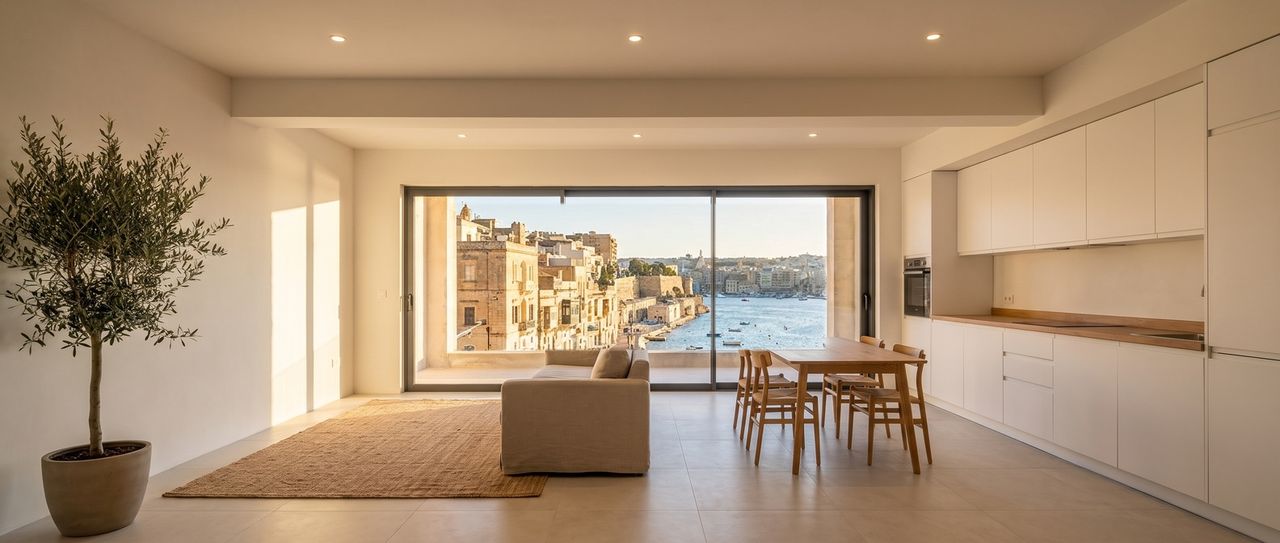
If you are buying your first home in Malta as a shell or off-plan, three Housing Authority schemes and one duty relief may apply. Each has its own rules. A shell adds a few catches, because you are buying something you cannot live in yet.
Important: Budget 2027 was presented on 26 October 2026, the day this guide was written. Its measures were not yet published, so every figure here is pre-Budget and may change. We point out the pending items below.
The First-Time Buyer Scheme (EUR10,000 grant)
This scheme pays a grant of EUR10,000. It comes as EUR1,000 a year over 10 years, paid each June 1. To qualify, the property must be:
- your first property, acquired after 1 January 2022
- bought with a bank home loan
- used exclusively as your ordinary residence
Budget 2026 kept this grant and made it permanent 2. It also changed one rule. A previous purchase of non-residential property, such as a garage or a field, no longer removes your first-time buyer status 2.
We could not confirm the application deadlines for this grant from an official source. Ask the Housing Authority when you must apply after your deed.
The 10% Deposit Payment Scheme
This scheme helps if you cannot raise the 10% deposit. The bank lends the deposit as a personal loan over 25 years, and the Housing Authority pays the interest 1. It is for buyers aged 21 to 39 buying their first residential property. Bank criteria still apply 1.
The price cap is not settled in the sources we checked:
- The Housing Authority catalogue (November 2025) gives a cap of EUR225,000 1.
- A law firm's summary of Budget 2026 says the cap was raised to EUR250,000 2.
We could not load a Housing Authority scheme page confirming EUR250,000. Check the current cap with the Housing Authority before you rely on it.
For shell buyers, the key line is this. The property may be in shell form if it can be finished within the cap in total 1. So the cap covers the price plus finishing, not the price alone. For how a bank looks at a shell, see home loans for shell form.
The Grant on First Residence
This grant is the one most directly linked to a shell. It refunds a share of your fiscal receipts for finishing or construction works. It pays up to EUR5,824, plus EUR1,165 for properties built before 1990, in two instalments. The applicant must be over 24 1.
The catalogue we sourced does not state what share of the receipts is refunded. Ask the Housing Authority for the current percentage. In practice, keep every fiscal receipt from your contractors and suppliers. Without them, you have nothing to claim against.
Duty relief on your first home
This is not a Housing Authority scheme, but it matters most at the deed. For onerous transfers on or after 28 October 2025, a first-time buyer pays no duty on the first EUR200,000, if:
- the property qualifies as your sole ordinary residence
- you have never acquired inter vivos any residential immovable property. This includes land, airspace, or property with a permit or permit application to build a residence
- the notary records your declaration and warns you about its truthfulness
- legal evidence goes to the Commissioner for Revenue with the article 51 form
A prior undivided share under 25% of the property's real value is ignored, unless relief was claimed on it before. The rule has no end date. Above EUR200,000, the normal duty rates apply 3. Your notary can confirm the exact duty on your price. Our guide to stamp duty for first-time buyers covers this in more depth.
The law allows the EUR200,000 threshold to be raised by subsidiary legislation, so a change would not need a new Act 4.
How the schemes fit together
The schemes do different jobs:
- Duty relief lowers the tax at the deed.
- 10% Deposit Scheme helps you get the loan started.
- First-Time Buyer Scheme pays back EUR1,000 a year once you own and live there.
- Grant on First Residence refunds part of your finishing costs.
The sources we checked list each scheme separately. They do not state in the material we sourced whether you can claim all of them together. Many buyers will meet the conditions for more than one. Confirm with the Housing Authority which ones you can stack before you build your budget on them. Eligibility for foreign buyers is also not covered in our sources, so check this with the Housing Authority too.
Worked example
This is an illustration only, using pre-Budget figures.
A couple, both 30, agree a shell at EUR190,000. They estimate finishing at EUR40,000. Total: EUR230,000.
- Duty: the price is below EUR200,000. If they qualify, no duty is charged on the transfer 3.
- Deposit scheme: 10% of EUR190,000 is EUR19,000. But price plus finishing is EUR230,000. That is over the EUR225,000 catalogue cap, and under the reported EUR250,000 cap 1 2. Whether they qualify depends on which cap is in force. They must confirm this before signing.
- Finishing grant: they claim against fiscal receipts, up to EUR5,824 1.
- FTB grant: with a bank loan and the home as their ordinary residence, EUR1,000 a year for 10 years 1.
One small change, such as a finishing estimate that rises, could push them out of the deposit scheme. Get a realistic finishing figure early. See what finishing a shell costs.
Catches when the property is unfinished
- The finishing counts toward the deposit cap. A cheap shell with an expensive finish can exceed it.
- "Ordinary residence" rules. The FTB grant and duty relief depend on the home being your residence. A shell cannot be lived in until finished. Ask the Housing Authority and your notary how this applies to your timing.
- Past airspace or plots. If you ever bought land or airspace with a permit or permit application for a residence, you may not be a first-time buyer for duty 3.
- Off-plan timing. The duty rule applies by the date of the transfer 3. With off-plan, the promise of sale and the final deed can be far apart. Ask your notary which rules will apply on your deed date.
- Receipts. The finishing grant needs fiscal receipts. Cash jobs without receipts cannot be claimed.
What Budget 2027 might change (unconfirmed)
Before the speech, these were pledges only. None was confirmed when we wrote this:
- raising the first-time buyer duty exemption from EUR200,000 to EUR300,000 6
- raising the 10% deposit scheme cap to EUR300,000 6
- My First Home: an interest-free government loan of up to 25% of the property value for first-time buyers over 23, repayable until age 65. Singles earning under EUR40,000 would qualify for property up to EUR300,000, and couples earning up to EUR60,000 for property up to EUR350,000 5. This was a proposal.
A secondary source also reports that some measures expire on 31 December 2026 with no extension announced. These include a duty exemption on the first EUR750,000 for UCA, older vacant and traditional-style properties, and related grants of EUR15,000 (Malta) and EUR40,000 (Gozo) 6. We found no official source confirming these figures or the expiry date. Re-check all of this after the Budget and against the legal notices that follow.
Next steps
Work out your total budget before you commit. Use the cost-to-own calculator at /calculators/ to check duty, and the finishing budget calculator there to see whether price plus finishing stays within the deposit scheme cap. When you have a figure, get finishing quotes so your estimate rests on real prices and proper fiscal receipts. Then confirm your eligibility with the Housing Authority and your notary before you sign.
Questions people ask
Can I use the 10% Deposit Scheme on a shell-form property?
The Housing Authority catalogue says yes, if the property can be finished within the scheme cap in total. The catalogue gives that cap as EUR225,000. A Budget 2026 report says it was raised to EUR250,000, but we could not confirm this on a Housing Authority scheme page. Check the current cap with the Housing Authority before you sign.
How is the EUR10,000 First-Time Buyer grant paid?
It is paid as EUR1,000 a year over 10 years, each June. It applies to a first property acquired after 1 January 2022, bought with a bank home loan and used exclusively as your ordinary residence. Budget 2026 made the grant permanent.
Do first-time buyers pay stamp duty in Malta?
For qualifying transfers on or after 28 October 2025, no duty is charged on the first EUR200,000, if the buyer has never acquired residential property before and the notary records the required declaration. Above EUR200,000 the normal rates apply. Your notary can confirm the amount on your deed.
Has Budget 2027 changed these schemes?
Budget 2027 was presented on 26 October 2026, but its measures were not published when this guide was written. Pledges such as a EUR300,000 duty exemption, a EUR300,000 deposit scheme cap and the My First Home loan are unconfirmed. Re-check against the legal notices that follow the Budget.
Sources
- Housing Authority, Housing Authority Schemes Catalogue (Nov 2025). · checked 26 Oct 2026
- CC Malta (Camilleri Cassar Advocates / ccmalta.com), Property tax and stamp duty measures in the Malta Budget 2026. · checked 26 Oct 2026
- Government of Malta / legislation.mt, Exemption of Duty in terms of article 23 (Amendment) Order, 2025 (L.N. 305 of 2025). · checked 26 Oct 2026
- Government of Malta / legislation.mt, Duty on Documents and Transfers Act (Cap. 364), art. 32(4). · checked 26 Oct 2026
- Business Now, MDA: Government's proposed 25% interest-free loan addresses affordability in the right way. · checked 26 Oct 2026
- Pedament, Malta Budget 2027: Property & Housing Proposals. · checked 26 Oct 2026
General information, not legal, tax or financial advice. Ask your notary, advocate or perit about your own purchase. Provenance: drafted with an AI model (Claude, Anthropic) from the sources listed, and edited for this site.